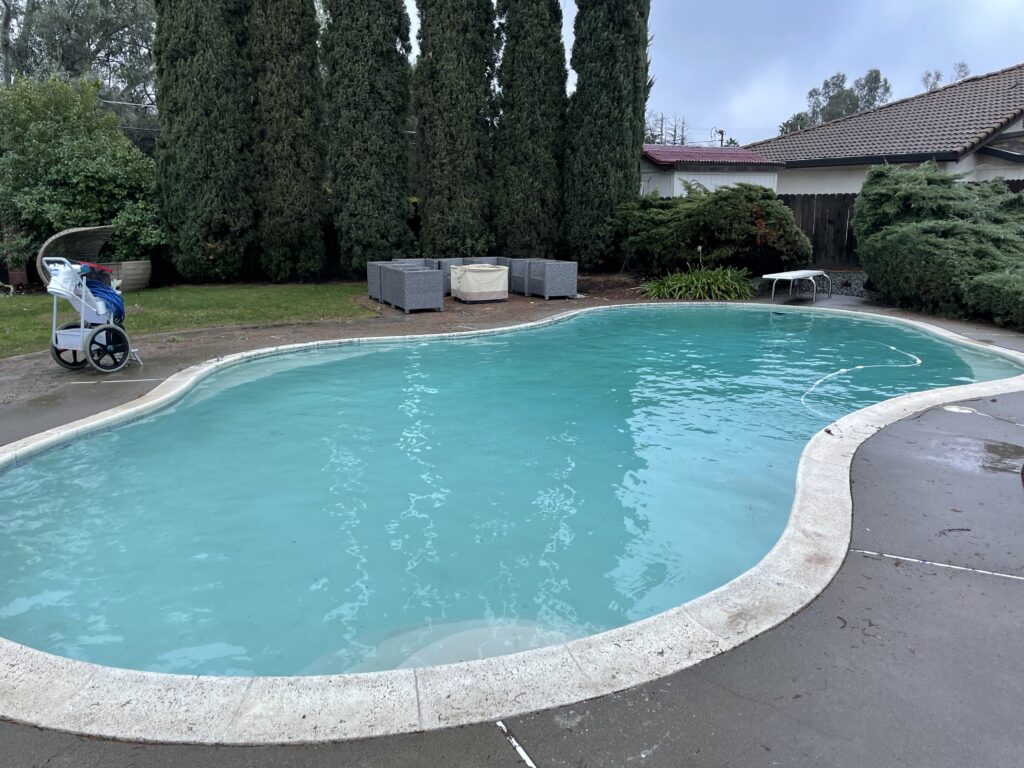
Why Is My Pool Cloudy? A Summer Guide for Elk Grove Pool Owners
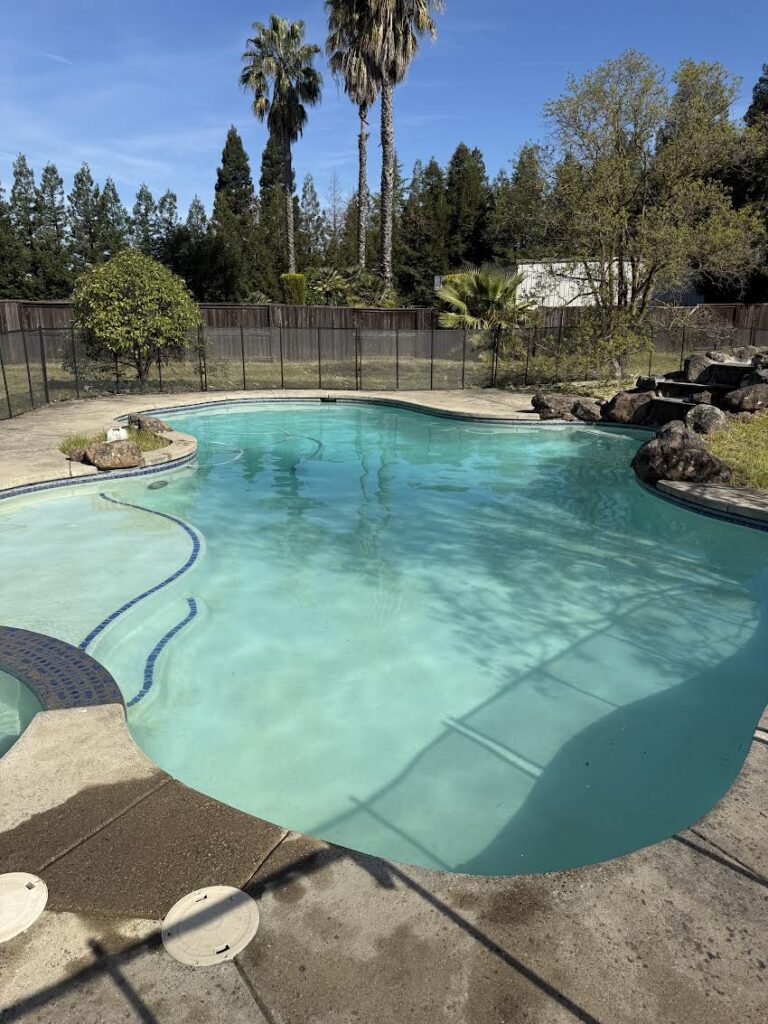
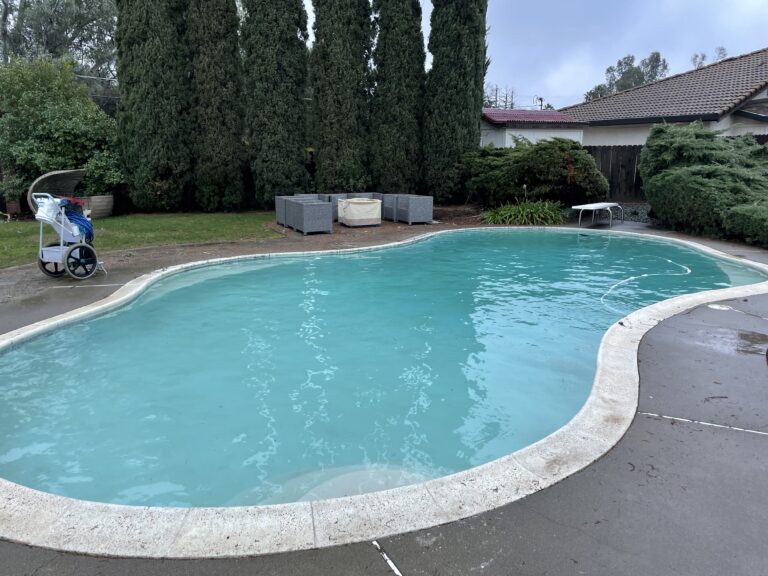
Cloudy pool water is one of the most common calls we get in July. A pool that sparkled on Friday turns milky by Sunday after a weekend of triple-digit heat and a backyard full of swimmers. The good news: cloudy water is a warning, not a disaster. The catch: in an Elk Grove summer, a cloudy pool can turn green within a few days if nobody deals with it.
Here’s what’s actually going on in the water, how to clear it, and how to tell when the problem is bigger than a bottle of chemicals.
What cloudy pool water actually means
Cloudiness is millions of tiny particles hanging in the water. Your filter isn’t catching them and your chlorine isn’t breaking them down. Almost every cloudy pool we see traces back to one of three things:
- Sanitizer: not enough active chlorine to keep up with what’s going into the water
- Water balance: pH, alkalinity or calcium out of range, so minerals come out of solution
- Filtration and circulation: the filter or pump isn’t moving and cleaning enough water
Fix the right one and the water clears. Guess wrong and you can pour in chemicals all weekend without seeing a difference.
The most common causes in an Elk Grove summer
Chlorine is getting used up faster than it’s added
Sun, heat and swimmers all burn through chlorine. On a 105-degree July day, a pool that held its chlorine fine in May can drop to almost nothing by evening. Sunscreen, sweat, body oils and a Fourth of July pool party add a lot of demand at once. When free chlorine bottoms out, bacteria and organic debris build up faster than the filter can catch them, and the water turns hazy.
Too much stabilizer (the “chlorine lock” problem)
Most chlorine tablets contain stabilizer, also called cyanuric acid or CYA. Stabilizer protects chlorine from the sun, which is helpful. But it never leaves the water except by splash-out and draining. Every tablet adds a little more, so a tab-fed pool can climb from a healthy level in spring to well over 100 ppm by August.
Pool owners call this “chlorine lock.” The chlorine isn’t actually locked. It’s just slowed down so much that a normal reading on a test strip isn’t strong enough to keep the water clear. The higher your stabilizer, the more chlorine you need. At 50 ppm stabilizer, you want free chlorine around 4 ppm, not the 1 to 3 ppm printed on most bottles.
High pH and calcium coming out of the water
Every inch of water that evaporates leaves its minerals behind, and every top-off from the hose brings in more. Over a hot summer, calcium and alkalinity creep up. When pH rises above about 7.8, that calcium starts to come out of solution as fine white particles. The result is a milky, slightly white haze rather than a dull green one.
A dirty filter or not enough run time
A filter loaded with summer dust, pollen and sunscreen can’t catch fine particles. Watch your filter’s pressure gauge. When it climbs well above its normal clean reading, flow drops and the water stops getting polished. Our pool filter cleaning page covers how sand, cartridge and DE filters each get cleaned.
Run time matters too. Many homeowners cut pump hours to stay off SMUD’s evening peak. That makes sense for the electric bill, but in July and August most pools need more total filtration time, not less. A variable-speed pump running longer at low speed is usually the best of both.
Early algae
If the haze has a green or teal tint, or the walls feel slick when you brush them, algae is already starting. That’s the stage just before a full green pool. Catching it now is far easier and cheaper than our Green-to-Clean treatment later.
Phosphates and debris
Leaves, pollen, lawn fertilizer and dust blown in from nearby construction all add phosphates and organic material. They don’t cloud the water directly, but they feed algae and raise how much chlorine the pool needs every day.
Cloudy right after shocking
Some cloudiness for 24 to 48 hours after a heavy shock is normal, as long as the pump is running. If it lingers, the shock itself may be part of the problem. Calcium hypochlorite shock raises both calcium and pH, which can tip already-hard water into that milky haze.
How to clear a cloudy pool, step by step
- Test everything, not just chlorine. Check free chlorine, pH, alkalinity, calcium and stabilizer. Test strips are fine for a quick check, but a drop kit or a pool store water test is more accurate for stabilizer.
- Correct pH first. Bring it into the 7.4 to 7.6 range. Chlorine works much better at lower pH, and calcium stays dissolved.
- Raise chlorine to match your stabilizer. Use liquid chlorine so you don’t add more stabilizer or calcium. Keep it there until the water clears.
- Run the pump around the clock. Leave it on 24 hours a day until the water is clear again.
- Clean or backwash the filter. Check the pressure gauge before and after. A clean filter clears a pool dramatically faster.
- Brush and vacuum. Brush the walls, steps and floor to knock loose anything settling, then vacuum it out.
- Use clarifier as a helper, not a fix. Clarifier clumps fine particles so the filter can catch them. It won’t fix low chlorine or high pH. For severe cases, a flocculant drops everything to the floor to vacuum out to waste. That only works on sand and DE filters, since cartridge filters can’t vacuum to waste.
Most cloudy pools clear within 24 to 72 hours once the real cause is fixed.
When cloudy water is a sign of a bigger problem
If you’ve held proper chlorine and run the pump nonstop for three days and the water is still hazy, chemicals probably aren’t the issue. Call a pro when you notice:
- No improvement after 72 hours. The filter is likely the culprit: torn DE grids, worn-out cartridges, or sand that’s channeling. Our pool filter repair team sees all three every summer.
- Stabilizer over 100 ppm. No amount of chlorine is practical at that level. Replacing part of the water is usually the only real fix.
- Air bubbles in the pump basket or weak return flow. These point to a suction leak or a failing pump.
- Cloudiness that comes back every week. The routine is off, not just one bad weekend.
How to keep your pool clear the rest of the summer
- Test at least twice a week in July and August, not once.
- Use liquid chlorine for part of your routine so stabilizer doesn’t keep climbing.
- Run the pump longer during heat waves.
- Brush the walls and steps weekly, even when they look clean.
- Clean the filter mid-summer instead of waiting for fall.
- Add extra chlorine after pool parties and big storms.
Frequently asked questions
Is it safe to swim in a cloudy pool?
No. If you can’t clearly see the main drain at the deep end, nobody should swim. Cloudy water hides swimmers in trouble, and it usually means the chlorine isn’t keeping up.
How long does it take to clear a cloudy pool?
Usually 24 to 72 hours once chlorine, pH and filtration are corrected. If it takes longer, the filter or high stabilizer is usually the reason.
Why is my pool cloudy after I shocked it?
Some haze is normal for a day or two while the filter catches what the shock broke down. If it lasts longer, check pH and calcium. Calcium-based shock can push hard water into a milky haze.
Does pool clarifier work?
Yes, but only as a helper. Clarifier helps the filter catch fine particles. It won’t fix low chlorine, high pH or a dirty filter.
Tired of chasing cloudy water? Let us handle it
Summer pool care in Elk Grove is a moving target. Chlorine demand changes with every heat wave, stabilizer builds up week by week, and filters load up faster than most people expect. That’s exactly what our weekly pool service is built for.
We test and balance the water, brush, vacuum, empty the baskets and check your equipment on the same day every week. After each visit you get a service report with a photo and the chemicals we added. Service starts at $185 a month with chemicals included. We cover Elk Grove, Laguna, Sacramento and the surrounding area.
If your pool is cloudy now and won’t clear, call us at (916) 892-0684 or request a free quote online. We’ll find the cause before it turns green.