Should You Drain Your Pool This Fall? When Elk Grove Pools Need Fresh Water
By September, a lot of Elk Grove pools are worn out. Months of chlorine tablets, triple-digit heat and daily top-offs from the hose leave behind stabilizer, calcium and dissolved solids that never evaporate. Chemicals that worked fine in May stop working, and the water just won’t stay right.
That’s usually when people ask us, “Should I drain my pool?” Sometimes the answer is yes, sometimes a partial drain is enough, and sometimes the water is fine and something else is wrong. Here’s how to tell, and why early fall is the best time to do it here.
How often should you drain your pool?
There’s no fixed calendar. A well-maintained pool can go several years between drains. A pool fed mostly by chlorine tablets in our climate may need fresh water much sooner.
The better rule: drain based on what the water test says, not how long it’s been. Each of these numbers tells you something different.
Signs your pool needs fresh water
- Stabilizer (cyanuric acid) over about 100 ppm. Every tablet adds stabilizer, and only draining removes it. At high levels, chlorine becomes too sluggish to keep the water clear without huge doses. We explained this “chlorine lock” problem in our post on why pools turn cloudy.
- Very high calcium hardness. Evaporation concentrates minerals. Look for white scale at the waterline, rough surfaces, and a milky haze that keeps coming back.
- High total dissolved solids. Years of chemicals and top-offs build up. The water can taste salty in a non-salt pool or look dull even when it’s balanced.
- Chemistry that won’t hold. You keep adding chlorine and adjusting pH, and the numbers drift right back.
- After a severe algae or contamination problem. Some green pools can be saved with our Green-to-Clean treatment. Black algae, a pool left sitting for months, or heavy debris often calls for a full drain and clean.
- Before resurfacing or certain repairs. Plaster, tile and some equipment work need an empty pool.
Partial drain or full drain?
Partial drain or full drain?
You don’t always need to empty the whole pool. A partial drain dilutes the problem in proportion to how much water you replace.
For example, if stabilizer is at 120 ppm and you replace about a third of the water, it drops to roughly 80 ppm. Replace half and it drops to around 60 ppm.
A partial drain is usually the better choice when the problem is just high stabilizer, calcium or dissolved solids. It’s faster and uses less water. It also keeps most of the plaster underwater, which protects it.
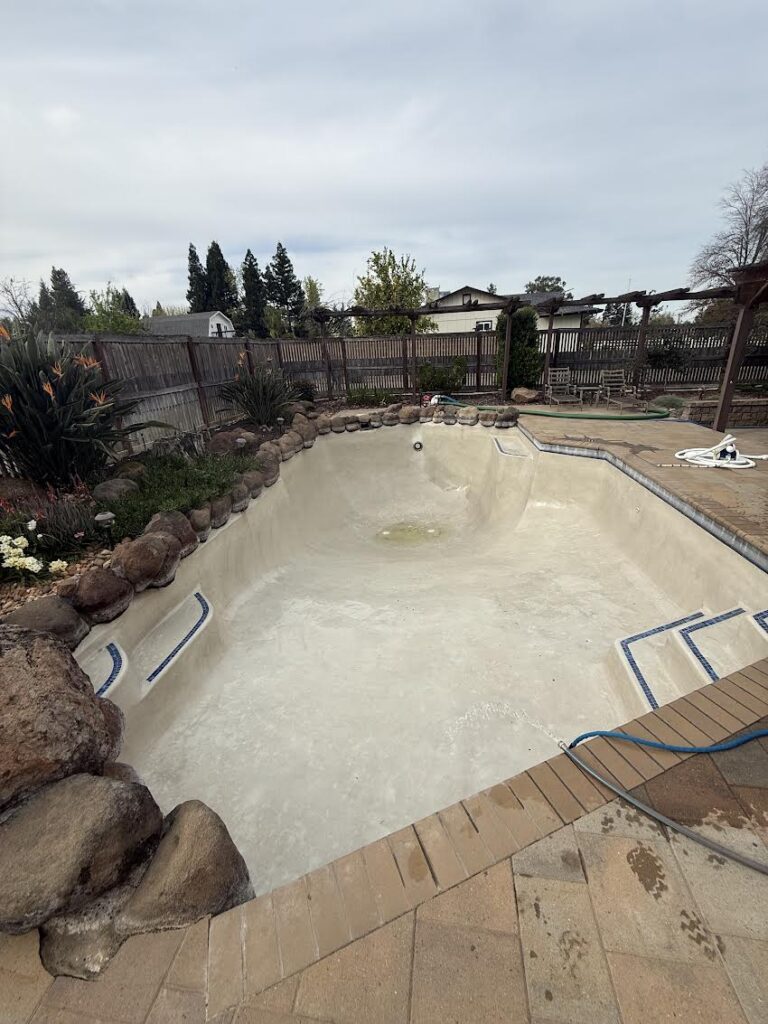
A full drain makes sense when the water is badly contaminated, the surface needs an acid wash or chemical wash, or a repair requires an empty pool.
Why early fall is the best time to drain in Elk Grove
Timing matters more than most people realize.
- Summer heat is hard on an empty pool. Plaster and pebble finishes are meant to stay underwater. Exposed to 100-degree sun, they can dry out, check and crack. Fresh fill water also needs extra chlorine right away in hot weather.
- Winter rain brings a different risk. When the ground is saturated, groundwater pushes up on the pool shell. An empty pool sitting in wet soil can shift or even lift.
- September and October hit the sweet spot. The weather is mild, the ground is still dry, and the busy swim season is over. Sacramento County’s own stormwater guidance points to spring and fall, when water is cooler, as the best time to handle pool water.
Where can pool water go? Local rules matter
You can’t just run a hose to the street. Under Sacramento County stormwater rules, chlorinated pool water, or water with other pool chemicals in it, is illegal to discharge into the storm drain system. The storm drain gutter in front of your house flows to local creeks, not a treatment plant.
Water can only go to a storm drain if it’s essentially chemical-free. That means:
- Chlorine below 0.01 ppm
- pH between 6.5 and 8.5
- No algaecides, copper, stabilizer or debris
- Not heated
Stabilizer alone rules out most residential pools.
The usual route is the sanitary sewer, through the sewer cleanout in your front or back yard. It has to be pumped slowly enough not to back up into your house or a neighbor’s. Saltwater pools may only be drained to the sanitary sewer, never the storm drain.
In Elk Grove and unincorporated Sacramento County, the sewer agency is the Sacramento Area Sewer District, (916) 876-6100. Call them before draining if you’re unsure. City of Sacramento residents should call (916) 808-5454. If you hire a pool company to drain your pool, make sure they follow these rules too. Homeowners can be held responsible for an improper discharge.
What a professional drain and clean involves
Our pool drain and clean-up service typically includes:
- Testing the water and inspecting the pool to confirm a drain is the right call
- Draining to the sewer cleanout at a safe, controlled rate
- Cleaning the surface with the method its condition calls for: a chlorine wash, acid wash or pressure washing
- Cleaning the pool equipment and filter
- Inspecting the pool and equipment while it’s empty
- Starting the refill right away so the surface doesn’t sit dry
- Coming back once it’s full to balance the water
The homeowner covers the water bill for the refill. Salt pools need an added salt rebalance. For scale, a typical 15-by-30-foot pool averaging 5.5 feet deep holds about 18,500 gallons.
Can you drain a pool yourself?
You can, but it’s riskier than it looks. Common problems include:
- Burning out a rental or sump pump that runs dry
- Flooding the house by pumping into the cleanout too fast
- Letting plaster bake in the sun because the refill started late
- Draining when the ground is wet and risking the pool shell lifting
- Discharging to the street and violating stormwater rules
If you do it yourself, drain in mild, dry weather. Go slow, and have a plan to refill the same day.
Frequently asked questions
How often should you drain your pool?
There’s no set schedule. Drain when testing shows stabilizer, calcium or dissolved solids are too high to manage, which may be every few years. Tablet-fed pools in hot climates often need it sooner.
How much does it cost to drain and clean a pool?
It depends on pool size, condition, cleaning method and whether it’s a salt pool, plus your water bill to refill. We quote after seeing the pool so you know the full price up front.
Does draining fix high cyanuric acid?
Yes. Replacing water is the only practical way to lower stabilizer. A partial drain lowers it in proportion to how much water you replace.
When can I swim after refilling?
Once the water is balanced and chlorine is at a safe level. On a standard refill that’s often within a day or two. After a new surface, follow the start-up schedule for that finish.
Not sure if your pool needs draining?
Start with a proper water test. We’ll check stabilizer, calcium and dissolved solids and tell you whether a partial drain will do the job or a full drain and clean makes more sense. Sometimes it’s neither, and we’ll tell you that too.
If you’d rather keep the water in good shape so draining stays rare, our weekly pool service balances chemistry with stabilizer buildup in mind. It starts at $185 a month, chemicals included. See our pool service cost guide for what that covers.
We serve Elk Grove, Sacramento, Laguna and nearby communities. Call (916) 892-0684 or request a free quote to get your pool ready for fall.